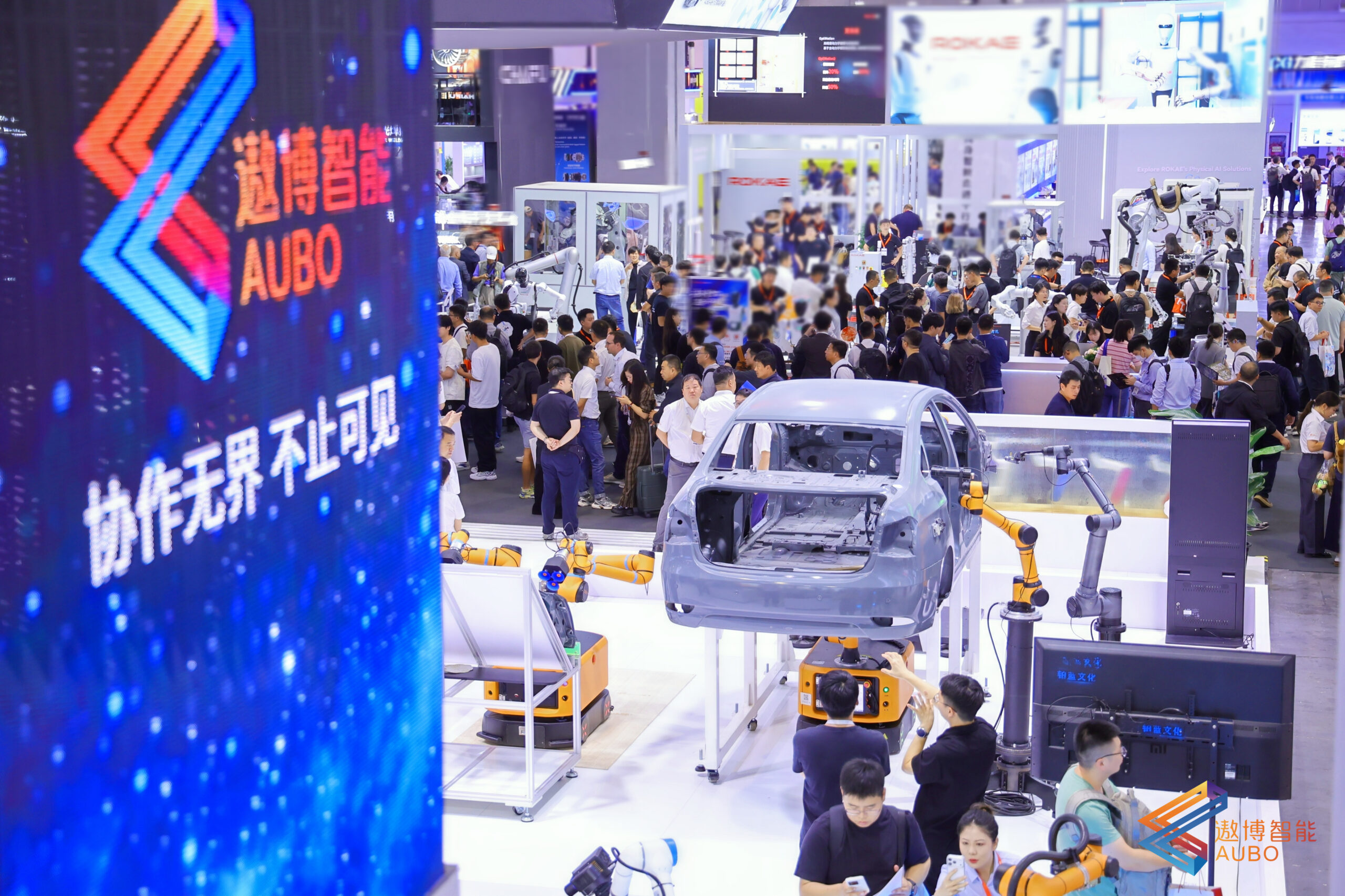
The 26th China International Industry Fair (CIIF) closed in Shanghai on October 16, 2026. AUBO used the show to put its newest collaborative robots to work in front of visitors, from heavy grinding to tomato picking.
On the industrial side, AUBO brought its G Series heavy-payload cobots, a mobile dual-arm robot and a teach-free welding workstation. The embodied AI side included the A Series dual arm, a dual-arm sorting robot and an agricultural picking robot. AUBO also picked up two awards at the fair, a CIIF Robot Award and a 2026 Innovative Enterprise honor.
Members of our AUBO Robotics USA team from Romulus, Michigan, worked the booth in Shanghai.
G Series: collaborative robots built for heavy payloads and core processes
AUBO showed two heavy-duty G Series models, the G35 and G40. Most cobots so far have handled light assembly and machine loading, and the G Series is built for heavier work in the middle of the production line.
Both arms carry high payloads, have force control in every joint, are rated IP67 and come in explosion-proof versions. That combination lets them work on core automotive processes like dispensing, painting, grinding and heavy assembly.
AUBO pitched the G35 for wide-area palletizing on both sides of a conveyor and for loading and unloading large machined parts.
The G40 is aimed at heavy grinding, dispensing and assembly.
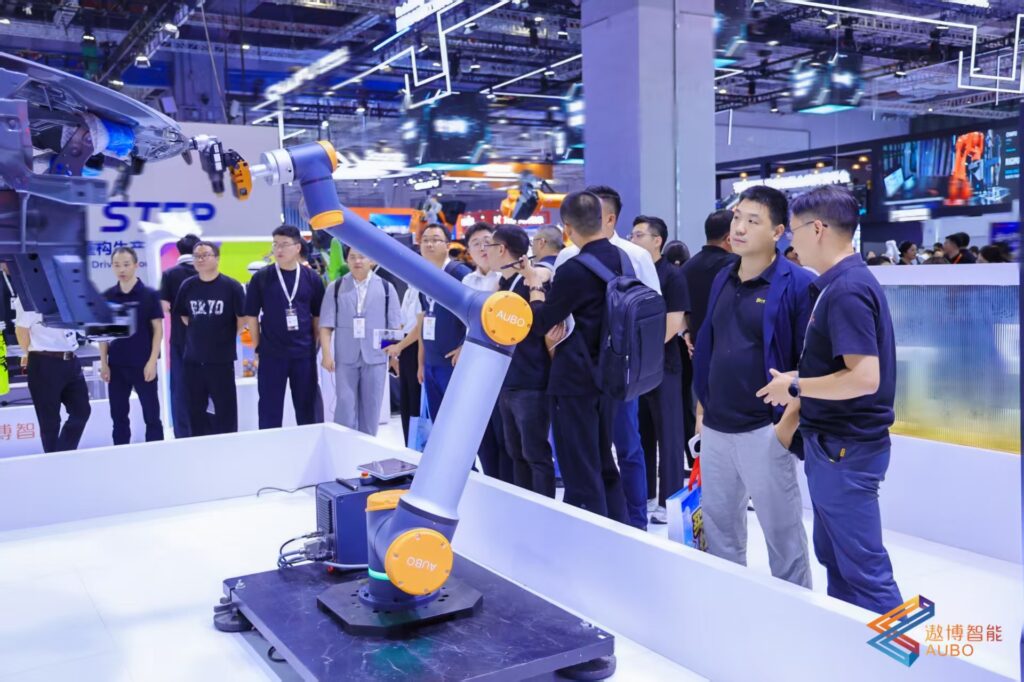
At the booth, a G40 ground automotive metal structural parts. Grinding without force control often removes too much material in some spots and misses others. The G40 keeps the contact force constant, so each part gets the same finish and fewer get rejected.
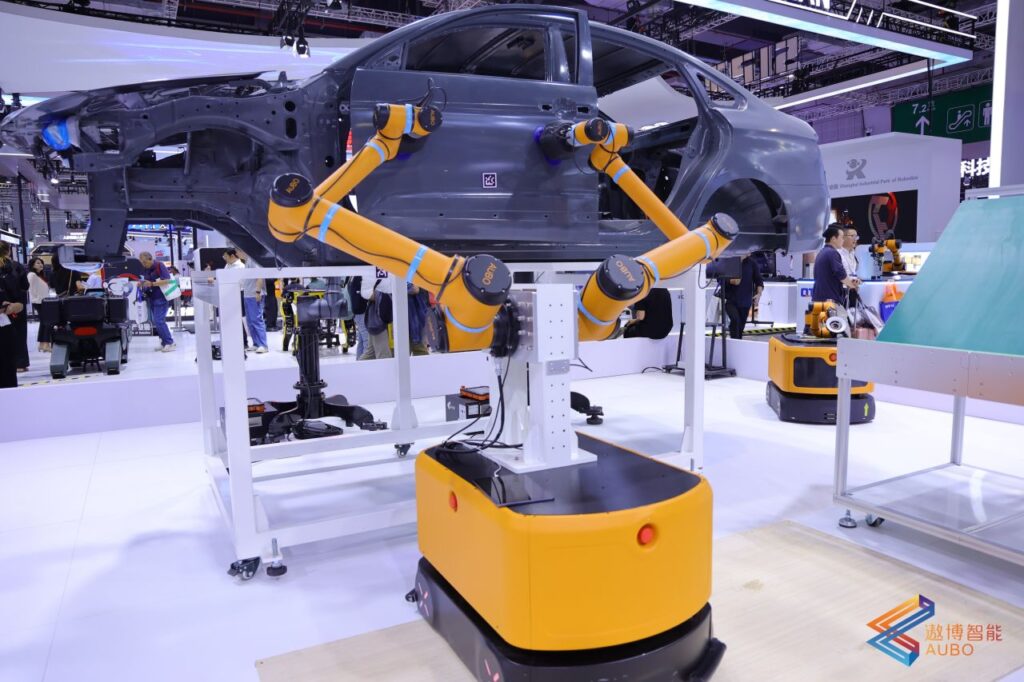
A mobile dual-arm robot for automotive assembly
The AUBO mobile dual-arm robot puts two AUBO-iS10 arms on a mobile base. It combines coordinated dual-arm motion planning, hybrid force/position control, 3D vision positioning and collision detection.
The two arms run as a leader and a follower. Engineers program the path, waypoints and force on the leader arm, and the system copies those settings to the follower so the arms don’t collide while sharing a task.
Each iS10 has ±0.03 mm repeatability and an IP67 rating. AUBO pitched the robot for automotive final assembly, where the pair can carry and fit heavy parts like doors on lines that build several models.
A single arm can’t do two-handed work and has trouble in tight, complex spaces. Single-arm cells also tend to lean on manual help and change over slowly. Adding a second, coordinated arm deals with each of these.
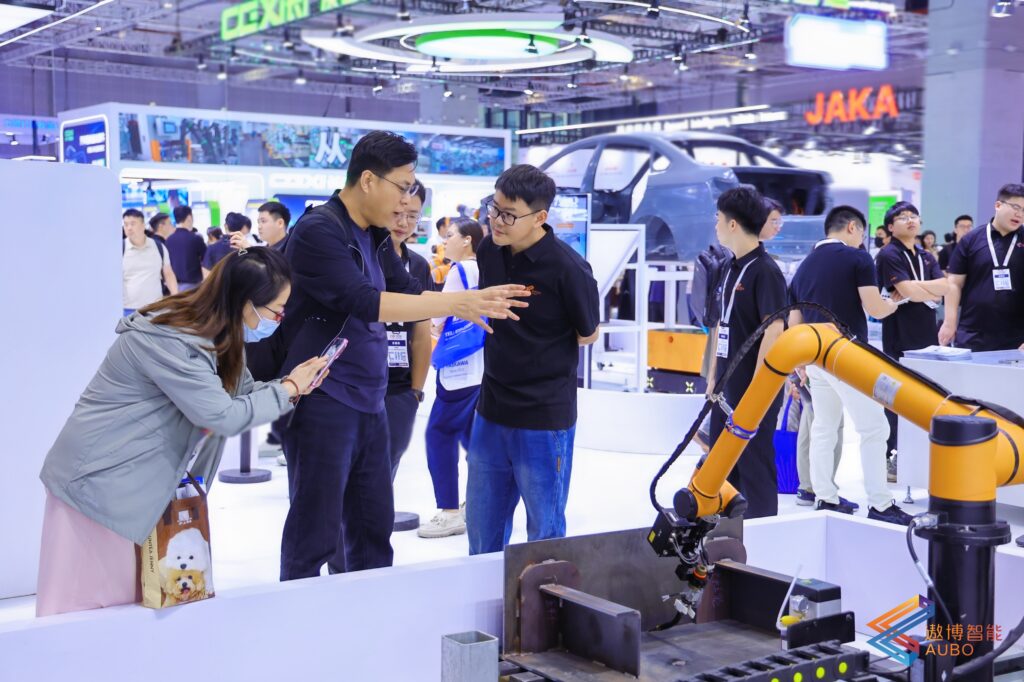
Teach-free welding with 3D vision
Conventional robotic welding means teaching the robot point by point. It takes a long time, depends on an experienced programmer, and the welder still works in a harsh environment.
AUBO’s teach-free welding workstation uses 3D vision to scan the part and find the seams itself. A built-in welding process package handles most of the setup, so the welder only fills in a template’s parameters and sets the camera positions before the station takes over.
In a single cell of a mid-sized sub-assembly, AUBO measured roughly 50% higher efficiency than with manual teaching.
Embodied AI: the A Series dual arm and a dual-arm sorting robot
The AUBO A Series dual arm has force control in every joint and built-in vision. Cables run inside the arm, and it uses AUBO’s ARCS operating system, with plenty of options for end-of-arm expansion.
It is designed to mount on many kinds of robot bodies: humanoids, four-legged robots and wheeled dual-arm platforms. AUBO lists uses such as AI data collection, training large embodied AI models, flexible assembly, precision handling, inspection rounds and research.
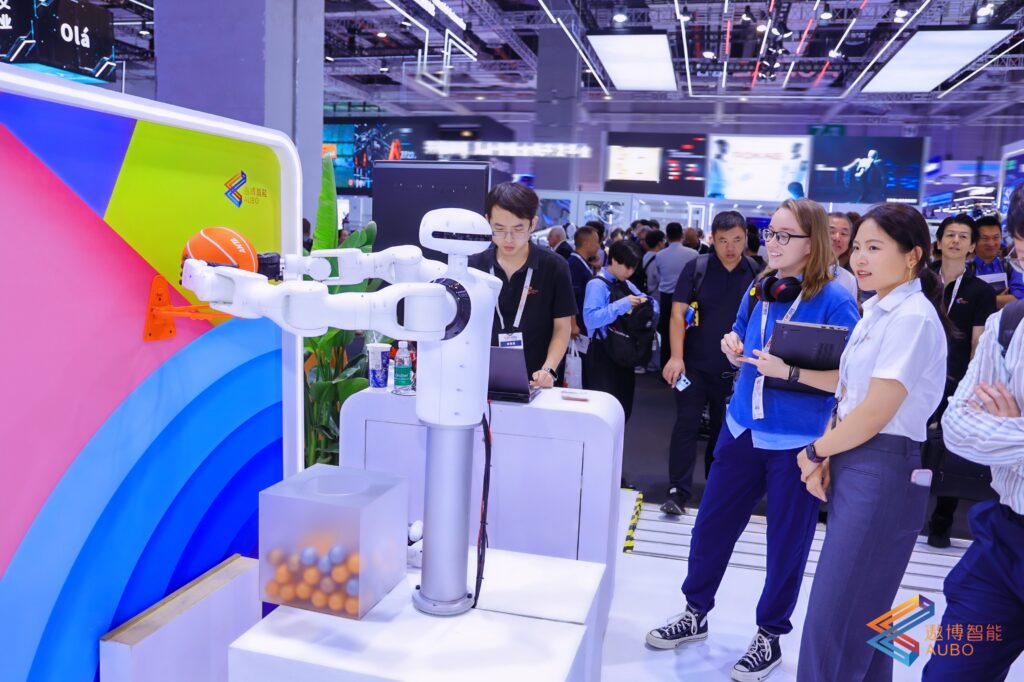
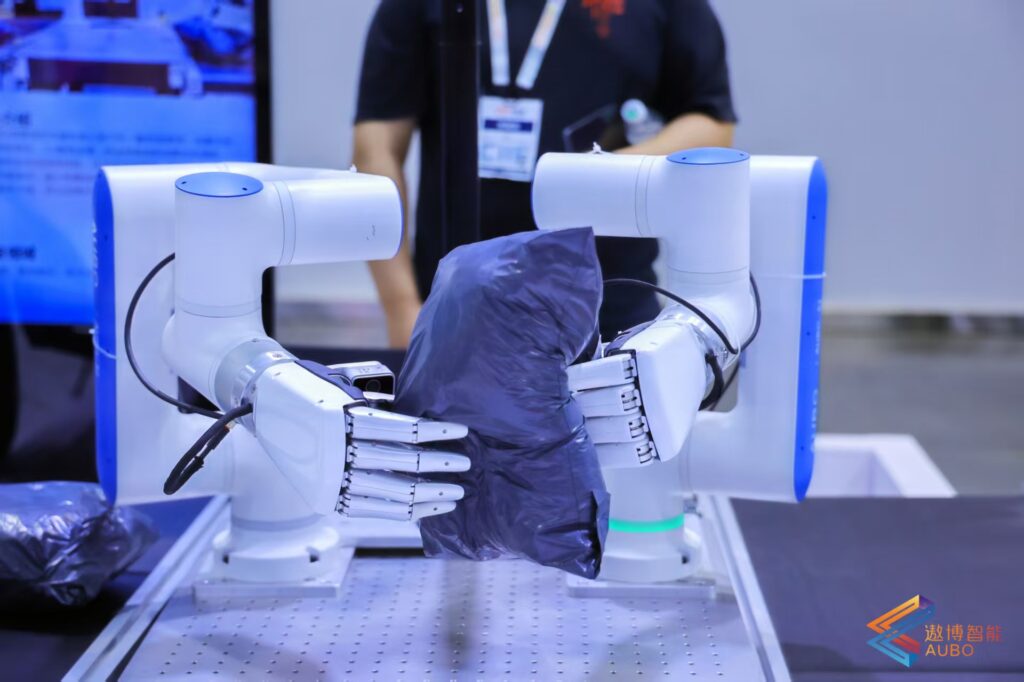
AUBO showed the dual-arm sorting robot for parcel hubs, e-commerce warehouses, postal sorting centers, returns processing and flexible receiving. Mixed parcels are hard to sort because items stack and hide each other, soft poly bags slide, and sizes vary. That leads to missed picks, damage and line jams. With two arms picking at once, the robot cuts down on those errors and shortens the cycle time.
An agricultural picking robot that adapts to new settings
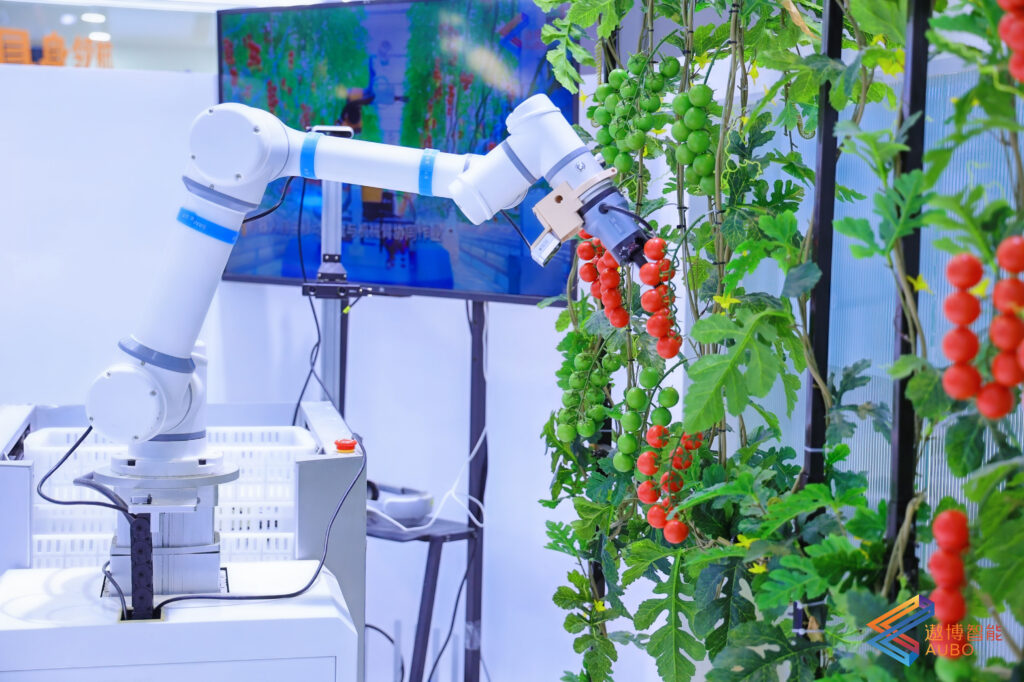
At CIIF, AUBO’s agricultural picking robot used a vision system to judge how ripe each tomato is, find it and keep a count of the fruit. It steers around obstacles so people nearby stay safe, and a collaborative arm picks each tomato without bruising it. The same machine scouts the rows and does the harvesting.
AUBO’s case for embodied AI in farming is adaptability. Once the robot is trained in one setting, it can use images, position data and other inputs to adjust to a new one, so growers and integrators don’t have to redevelop the system each time.
What this means for your plant
Across the booth, force control and vision were doing heavier, messier work than cobots usually get: grinding car parts, welding without teaching, handling heavy parts with two arms and picking ripe fruit. If you still think of collaborative robots as light-duty helpers, these demos are worth a look.
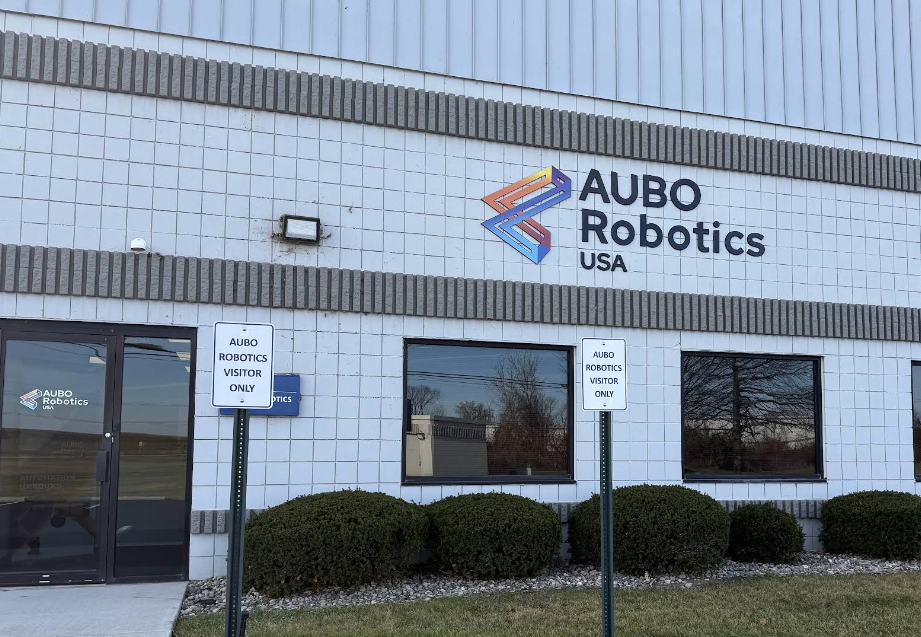
If you have questions about any of these demos, contact the AUBO Robotics USA team in Romulus, Michigan. You can also visit our training center there to see AUBO arms in person.