
PCBA Testing Automation in High-Mix Production: How BTL Uses an AUBO i10 Cobot
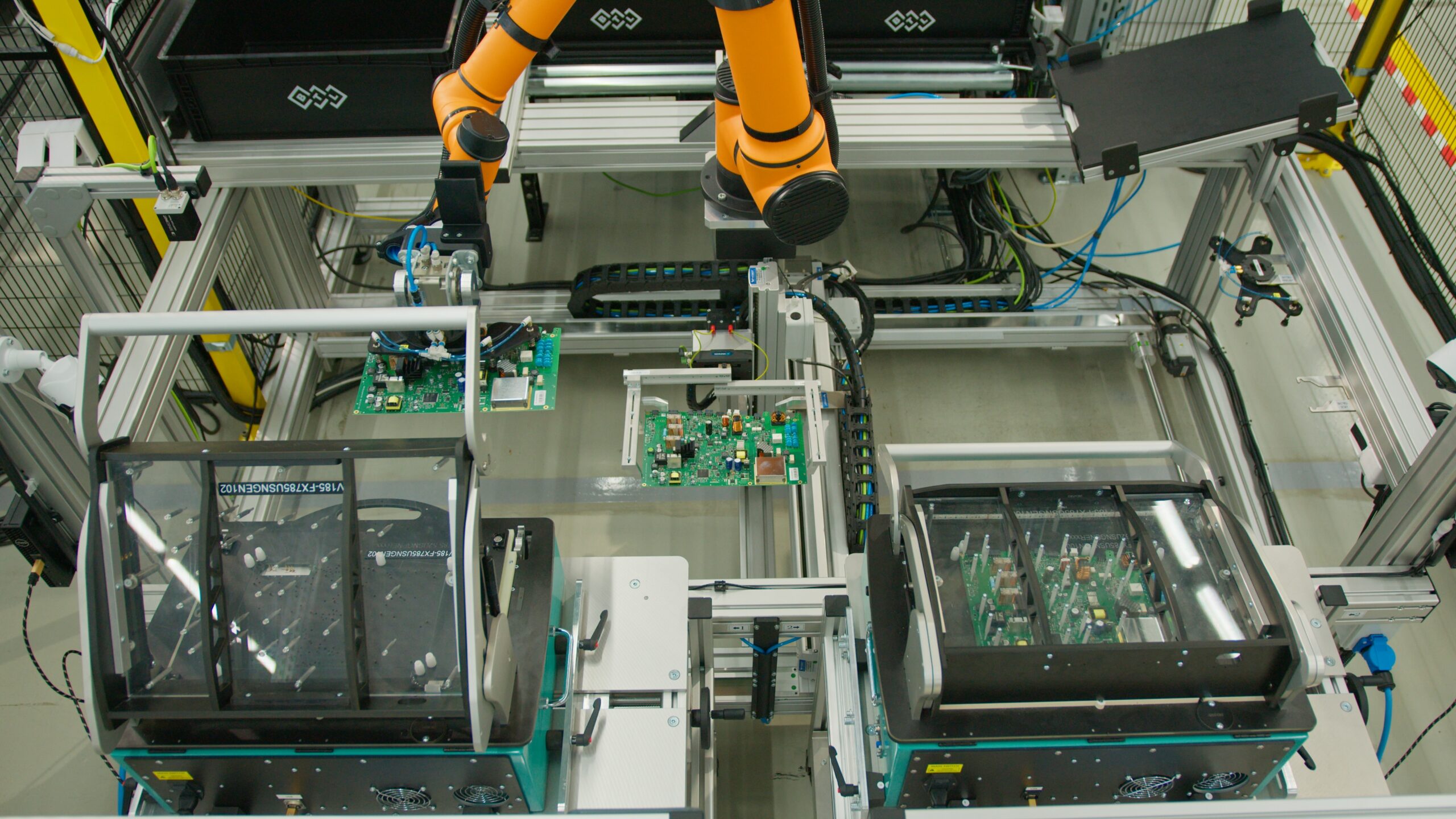
At BTL Medical Technologies in Benešov, near Prague, an AUBO i10 collaborative robot helps keep two testing stations supplied with printed circuit board assemblies (PCBAs), the populated boards used in BTL’s medical devices.
Integrated by KINALI into a Test-it-off workstation, the cobot takes over repetitive handling around existing electrical testers. The complete cell supports up to six hours of unattended operation, depending on the material buffer and operating conditions.
It is a practical example of PCBA testing automation in a plant with frequent product changes. For North American manufacturers, the same AUBO i-Series cobot technology is supplied and supported by AUBO Robotics USA from its headquarters and training center in Romulus, Michigan.
The PCBA Testing Challenge: High-Mix Production and Too Few Test Operators
BTL produces its PCBAs in-house. In a recorded customer interview, Jan Kříž, Head of Hardware at BTL, described approximately 300 board types, typically produced in batches of 100 to 150 units, with total annual production of roughly 300,000 to 400,000 boards.
These figures describe the factory’s production context, rather than the throughput of a single robotic workstation.
This is High-Mix, Low-Volume manufacturing: many product variants, relatively small batches, and frequent changes to the equipment and setup needed for testing. Automation must accommodate that variability while keeping preparation practical for the production team.
BTL also faced a shortage of people as production volumes increased. Its earlier testing process required trained employees with electrical knowledge. Routine board handling consumed some of that capacity, making the availability of testing operators a constraint on further growth.
How the AUBO i10 Automates PCBA Testing Around Existing Testers
The AUBO i10, a 10 kg payload cobot, performs the repetitive movements that keep boards moving through the test cell. It handles PCBAs before and after testing and automates operations around the fixtures.
Those movements form part of a coordinated workflow serving two testing stations, reducing the need for continuous manual tending.
Cobot Bin Picking, Tool Changing and a Dedicated Board Placer
Boards arrive unsorted in KLT material containers designed for handling sensitive electronics. A 3D vision system identifies their positions and guides bin picking by the AUBO robot.
The documented configuration also includes a TripleA automatic tool changer, allowing interchangeable tools to be used on the robot. The handling arrangement can therefore accommodate the tooling requirements of different PCBA types.
KINALI also incorporated PCBPlacer, a custom three-axis manipulator with a SCHUNK gripper for board placement. The AUBO arm and this dedicated manipulator share the handling work under Test-it-off’s control.
ICT and FCT Tester Automation Without Replacing the Testers
BTL’s existing in-circuit testing (ICT) and functional testing (FCT) equipment performs the electrical tests. ICT checks electrical characteristics and connections on a board; FCT checks whether the assembly performs its intended functions.
After the testers evaluate the result, the workstation separates boards accordingly and links individual board identification with the test record. According to KINALI, robotic handling adds approximately 20 seconds to each test cycle.
Who Built the Cell
KINALI is a Czech engineering and technology company based in Brno and founded in 2006. It develops industrial software and delivers robotic automation and optical quality inspection systems. KINALI is also AUBO’s authorized distributor and a robotics integrator in Czechia.
KINALI developed Test-it-off as a modular platform combining robotic handling with software that coordinates PCBA testing, product variants, sorting, traceability, and reporting. It adapted and integrated the BTL workstation in cooperation with the customer’s engineering team.
Fast Changeovers for High-Mix, Low-Volume Production
For BTL, flexibility includes the preparation needed between batches. Fixtures can be staged on mobile trolleys outside the active testing cycle, allowing the production team to prepare the next setup while the current work is running.
Test-it-off’s guided interface supports setup and product changeovers without programming. KINALI reports changeovers in under 10 minutes and the introduction of new PCBA types in under 60 minutes at BTL.
The documented configuration also includes Data Matrix code reading, automated labeling, and integration with ERP and MES software. Live statistics and remote access let staff follow progress without standing beside the cell.
Automated notifications through the user interface, email, or SMS indicate when attention is required.
Results of PCBA Testing Automation at BTL
The material buffer supports up to six hours of unattended operation. Actual runtime depends on the product, test cycle, available input and output capacity, and whether an exception requires intervention.
In the customer interview, Kříž described a reduction in staffing needs of one to two people and explained BTL’s intention to move employees from monotonous work to tasks that robots could not perform. KINALI’s case study expresses the result across BTL’s three-shift operation as the equivalent of six operators.
The system also provides a repeatable handling sequence and connects board identification with test data. These functions support process consistency and traceability. Quantifying their effect on defect rates or yield would require a measured comparison before and after installation.
BTL cell at a glance (source: KINALI case study):
- Robot: AUBO i10 collaborative robot with TripleA automatic tool changer
- Testers: existing ICT and FCT equipment, up to two fixtures in parallel
- Material handling: 3D bin picking of unsorted PCBAs from KLT boxes
- Handling time: approximately 20 seconds in addition to the test cycle
- Changeovers: under 10 minutes; new PCBA types in under 60 minutes
- Unattended operation: up to six hours, depending on buffer and conditions
- Data: Data Matrix reading, labeling, ERP/MES integration, remote access
Is Cobot-Based PCBA Testing Right for Your Facility?
BTL’s application shows how an AUBO cobot can be used in a manufacturing process with frequent product changes. A similar approach may help where PCBA test equipment depends on repeated manual loading, fixture operation, unloading, or sorting.
The first step is to measure electrical test time separately from operator handling and product changeover time. That comparison shows how much tester capacity is currently waiting on people.
A suitable cell must fit the board geometry, fixture interfaces, product mix, material flow, and required data connections. Buffer capacity determines the available unattended window. Existing testers can be retained when their interfaces and operating requirements support integration.
From there, scope the payload and reach, select end-of-arm tooling from the AUBO Ecosystem of certified accessories, and complete a risk assessment for your specific application. Cell logic can be tested in AUBO’s AUBOPE simulation software before hardware is installed.
Local Cobot Support in North America
AUBO Robotics USA serves the North American market from Romulus, Michigan, where its warehouse, service department, training center, and technical support teams are based. Local spare parts inventory and domestic support help keep a production cell running.
AUBO cobots use an open architecture with SDK, Python, C++, and ROS integration, which helps integrators connect them to test equipment, vision systems, and factory software.
Frequently Asked Questions
What is PCBA testing automation?
It is the use of robots and software to load, unload, and sort printed circuit board assemblies around ICT and FCT testers, so electrical testing can continue with less manual tending. At BTL, an AUBO i10 cobot handles this work.
Can a cobot work with existing ICT and FCT testers?
At BTL, the cell operates the plant’s existing ICT and FCT equipment. Whether your testers can be retained depends on their interfaces, fixtures, and operating requirements.
How long can the BTL cell run without an operator?
Up to six hours, depending on the product, test cycle, buffer capacity, and whether an exception requires intervention.
Is the AUBO i10 available in the United States?
Yes. AUBO Robotics USA supplies and supports the AUBO i-Series, including the i10, across North America from Romulus, Michigan.
Next Steps
BTL’s cell shows that PCBA testing automation can work in high-mix production: an AUBO i10 cobot, 3D bin picking, and guided changeovers keep existing testers running for hours with less manual handling.
If your test equipment is waiting on operators, book a demonstration at our Romulus, Michigan training center or request a custom automation feasibility study.
To see the BTL project in more detail, read KINALI’s full BTL case study and watch the workstation in operation.