
Cobot vs. Industrial Robot: Which One Fits Your Plant?
Title goes in the WordPress title field, not the body.
In the cobot vs industrial robot decision, the biggest difference is where people stand. A collaborative robot (cobot) is designed to work near people, with built-in force and collision sensing. An industrial robot is built for maximum speed and payload, and usually works inside a guarded cell.
Neither is better in every case. The right choice depends on your parts, cycle times, floor space and how often your jobs change.
This guide compares the two side by side and shows when each one makes sense.
Cobot vs. Industrial Robot: Key Differences
The table below compares the two on the factors that usually decide a project.
| Factor | Collaborative robot (cobot) | Industrial robot |
|---|---|---|
| Working near people | Designed for it, with force and collision sensing, after a risk assessment | Usually separated from people by fencing or guarding |
| Payload | Light to medium; AUBO cobots range from 3 to 35 kg | Light to very heavy loads |
| Speed | Moderate, limited when people are nearby | Built for the highest cycle rates |
| Programming | Hand guiding and visual, drag-and-drop interfaces | Typically needs trained robot programmers |
| Floor space | Compact; fencing can often be reduced or eliminated | Larger cell, including the guarded area |
| Redeployment | Easy to move between jobs and lines | Usually fixed to one cell |
| Best for | High-mix work, frequent changeovers, tight spaces | High-volume, high-speed, dedicated production |
In short, cobots trade top speed for flexibility. Industrial robots trade flexibility for raw throughput.
When Each One Is the Better Choice
An industrial robot is usually the better fit when you have:
- Very heavy parts, beyond the 35 kg top end of AUBO’s cobot range.
- Very high cycle rates that a collaborative speed limit can’t meet.
- Long runs of one part on a dedicated, high-volume line.
- Room for a guarded cell, with no need for people to work alongside the robot.
A cobot is usually the better fit when you have:
- High-mix, low-volume work with frequent changeovers.
- Limited floor space for a fenced cell.
- Operators working nearby, loading parts or checking quality.
- No in-house robot programmers, or a team new to automation.
- Jobs that move, such as one arm shared between machines or lines.
Many plants use both. Industrial robots run the highest-volume lines, while cobots handle the flexible work around them.
Robot Safety Fencing and Floor Space
Robot safety fencing is one of the biggest practical differences. A typical industrial robot cell is enclosed by fencing, interlocked doors or light curtains, which adds cost and takes up floor space.
Cobots are built to work closer to people. They sense contact and stop or slow down, and their safety settings can be tuned to the task. Depending on your application, that can reduce or eliminate the need for costly fencing.
A cobot still needs a risk assessment before it goes into production. The relevant standards are ISO 10218 for industrial robot safety and ISO/TS 15066 for collaborative operation. AUBO cobots comply with both, and carry NRTL certifications for North America.
The tool matters as much as the arm. A sharp gripper, a welding torch or a heavy part can still require guarding, even on a cobot.
Cobot Programming and Changeovers
Traditional industrial robots are usually programmed by specialists, line by line. Every new part can mean waiting for a programmer and stopping the cell.
Cobot programming is built for the people already on your floor. With an AUBO cobot, operators can:
- Hand-guide the arm to each point, and the robot records the path.
- Build tasks visually with a drag-and-drop teach pendant.
- Get up to speed fast, with operator training that takes under 30 minutes.
For engineers, AUBO’s open architecture supports Python, C++ and ROS 1/2, plus an SDK for custom applications. Programs can be tested in AUBOPE simulation before the physical cell is built.
This is why cobots suit frequent changeovers. Re-teaching a job, or moving the arm to a new station, is a routine task instead of a project.
Comparing Total Cost, Not Just the Robot Price
The arm is only part of the cost. When you compare quotes, look at the total cost of ownership for each option:
- Guarding: fencing, interlocks and light curtains for an industrial cell.
- Integration: engineering time, fixtures and controls work.
- Programming: initial setup, plus every future changeover.
- Floor space: the area the cell takes, including its guarding.
- Training: how long it takes your team to run the system.
- Downtime and service: how fast you can get parts and support.
Cobots often come out ahead on guarding, programming and training. An industrial robot can still win on cost per part for very high-volume work.
AUBO keeps ownership costs predictable with turnkey systems like SwitchWeld and the Palletizer, local spare parts inventory, and support from its Romulus, Michigan headquarters.
Which AUBO Cobot Fits Your Application?
If a cobot is the right call, AUBO offers arms and turnkey systems for the most common jobs.
| Option | Payload | Best for |
|---|---|---|
| AUBO i Series (i3, i5, i10, i16, i20) | 3 to 20 kg | Assembly, machine tending, pick-and-place, screwdriving |
| AUBO iS Series | 3 to 35 kg | Heavier payloads and harsher environments, with IP ratings up to IP67 |
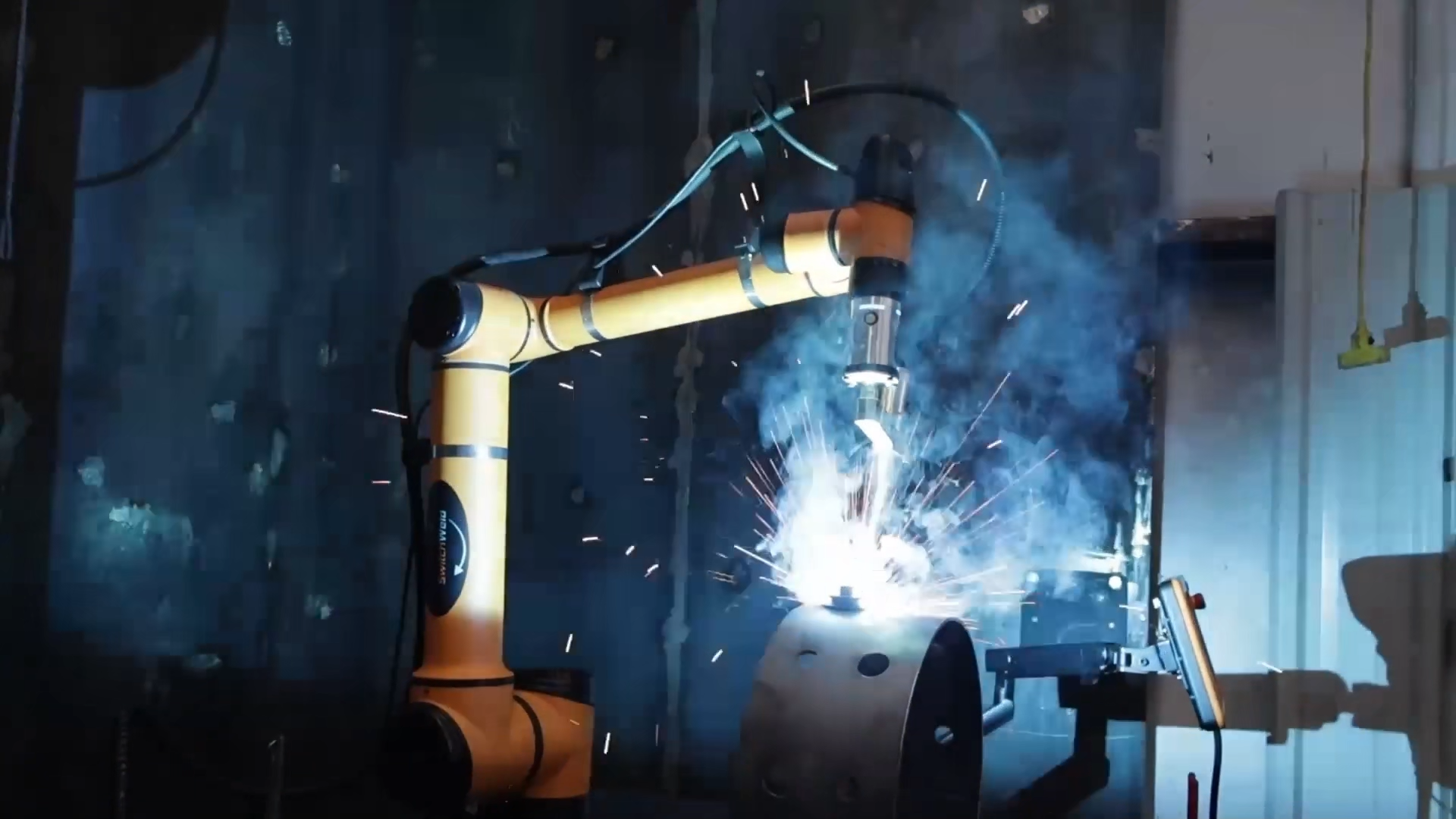
| SwitchWeld | Runs on i5, i10 or i20 | MIG welding and plasma cutting, taught by hand |
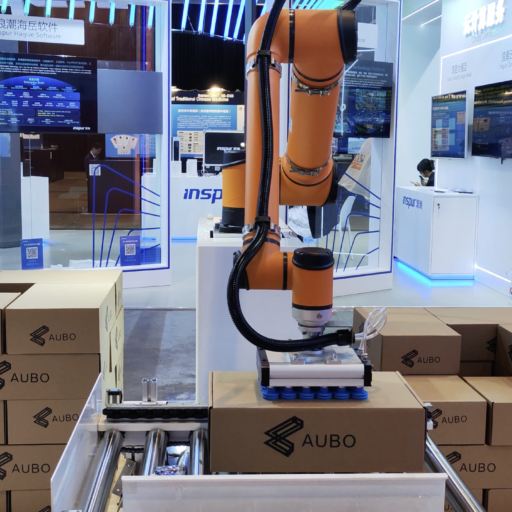
| AUBO Palletizer | 20 to 35 kg | End-of-line palletizing, deployed in under a day |
Not sure which fits? Start with your heaviest part, including the gripper, and the reach you need.
Cobot vs. Industrial Robot FAQs
What is the difference between a cobot and an industrial robot? A cobot is designed to work near people, with force and collision sensing, and is programmed by hand guiding or visual tools. An industrial robot is built for higher speed and payload, and usually works inside a guarded cell programmed by specialists.
Are cobots safer than industrial robots? Cobots are designed for safer collaboration, but no robot is safe by default. Every cobot application needs a risk assessment under ISO 10218 and ISO/TS 15066, and the tool and part can still require guarding.
Do cobots need safety fencing? It depends on your application and risk assessment. Cobots can reduce or eliminate the need for costly fencing in many cases.
Are cobots slower than industrial robots? Usually, yes. Cobots run at moderate speeds when working near people, while industrial robots are built for the highest cycle rates.
How much can a cobot lift? AUBO cobots range from 3 kg to 35 kg payload. Heavier parts usually call for an industrial robot.
Can my current team program a cobot? Yes. AUBO cobots are taught by hand guiding and a drag-and-drop interface, training takes 1-2 days.
Find the Right Fit for Your Plant
The cobot vs industrial robot choice comes down to your parts, speeds, space and people. Industrial robots win on heavy, high-speed, dedicated work. Cobots win where jobs change often, space is tight and operators work nearby.
Not sure which side your application falls on? Request an automation feasibility study, or book a demo at our Romulus, Michigan training center to see a cobot run your parts.
Want to see a cobot application in detail? Read our guides to cobot welding with SwitchWeld and the AUBO cobot palletizer.